
Introduction
The genetic selection of animals for business aiming at fast growth has led to a great number of positive but also to a lot of negative effects: increase of fat deposits and higher rate of metabolic disorders, physiological abnormalities, skeleton deformations and problems with the blood circulation.
These disadvantages as well as the related financial losses have led to increased interest in the techniques for sustainable breeding. They increase the productivity and at the same time minimize the growth-related problems.
Advanced scientific research have proved the enormous impact of light on the biological processes in living organisms and the potential for use in industrial breeding of animals.
Impact of the light on poultry
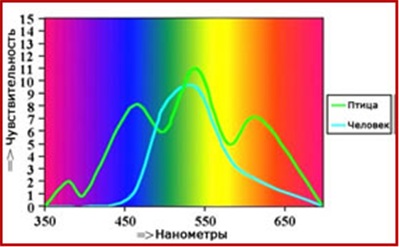
Poultry has its specific sensitivity to light and it is shown in the diagram. The proven influence of various light spectra on the psychological and physiological status of poultry may be successfully used in breeding broilers and parent flocks. With the use of the impact of light, we can regulate: the increase of body weight, speeding up or down the sexual maturation, reduction of stress, suppressing cannibalism, increase of laying eggs, regulation of the size of the eggs, increasing the fertility of cocks, reduced food consumption.
Impact of the light on cloven-footed animals
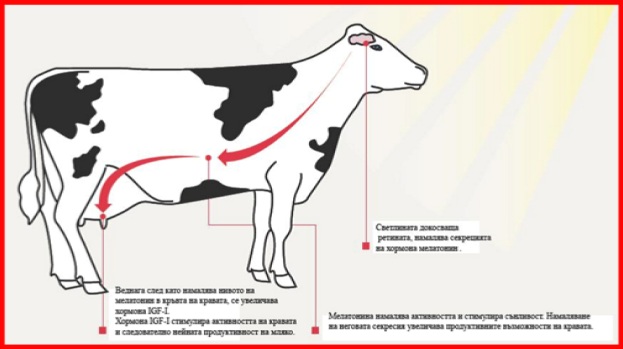
Light receptors are located in the retina of animals. Being illuminated by light, they send information to the brain and it controls an enzyme in the epiphysis which is used in the synthesis of Melatonin in the blood. As a result of this process, the duration of the day regulated the level of Melatonin. In its turn, the concentration of Melatonin affects the production of some hormones in the blood, for example the hormone /IGF-1/ growth factor -1.
Relation between Melatonin and the life cycle of animals:
1. Long period of illumination –> low contents of Melatonin-> high content of the hormone /IGF-1/ growth factor -1 –> stimulation of the grown and milk secretion.
2. Short period of illumination - > high contents of Melatonin- > low content of the hormone /IGF-1/ growth factor -1 -> Decrease of the growth and milk secretion.